
Biblical truth for people navigating life's struggles and seeking meaning. Join us every Sunday for hope, community, and answers to real problems.
Join us this Sunday for our next session in the series
This program is designed for individuals navigating life's struggles and seeking meaning, comfort, and hope through accessible biblical teaching. Our approach focuses on pastoral care through Scripture, providing deep examination of God's Word that speaks directly to hurting people.
We examine what Scripture actually teaches about the situations many of us face: loss, grief, financial difficulties, broken relationships, health problems, and the many other trials that God's Word addresses with hope and truth. This is biblical truth for people navigating loss, pain, and life's challenges while searching for hope, meaning, and God's presence.
"The Spirit of the Lord Jehovah is on Me, because Jehovah has anointed Me to bear good news to the poor one. He has sent Me to bind up the broken of heart, to proclaim liberty to captives, and complete opening to the ones being bound; to call out the acceptable year of Jehovah, and the day of vengeance of our God; to comfort all those mourning; to appoint to the mourning ones of Zion, to give them beauty instead of ashes, the oil of joy instead of mourning, the mantle of praise instead of the spirit of infirmity, so that one calls them trees of righteousness, the planting of Jehovah, in order to beautify Himself." - Isaiah 61:1-3
Study #2 — Series 4: "Growing Through the Struggle — Becoming Who God Wants You to Be." Following last week's look at Psalm 55 and the wounded heart, this study turns to what happens when self-protection slowly becomes isolation. Why does hurt so often make people withdraw from one another? And what does Scripture show us about staying connected — even imperfectly — when trust has been shaken?
Sunday at 2:30 PM PST/5:30 EST
~2 Hours
To be announced
Biblical study + Live Q&A
Watch previous Sunday Bible Study sessions and open forums. Each session includes biblical teaching on life's struggles, followed by live Q&A where we address real questions from real people seeking biblical truth for their pain.
Study #1 — Series 4: "Growing Through the Struggle — Becoming Who God Wants You to Be." It wasn't an enemy — it was a friend. Psalm 55 describes betrayal from one with whom David "sweetened counsel together" and "walked into the house of God." Fear, trembling, the desire to fly away like a dove — and then a widening lens onto violence and corruption in the city itself. Yet David keeps turning toward God in the middle of it: "Evening and morning and at noon I will complain and moan; and He will hear my voice." Includes Hebrew word studies on cast (TWOT 2398 — to throw, transfer, entrust) and shalom (TWOT 2401a — not merely absence of war but completeness, wholeness, unimpaired relationship). The Psalm doesn't end with David emotionally resolved — but with continued prayer through unresolved pain. Next week: Study #2 — Building Community When You Feel Alone.
Psalm 55, Psalm 56:8, Lamentations 3:21–23
Study #10 — the final study in Series 3: "Finding Strength and Purpose." Paul's argument moves through a chain of "if… neither…" — if dead ones are not raised, Christ has not been raised; if Christ has not been raised, preaching is worthless, faith is worthless, and "the ones that fell asleep in Christ perished." Four contrasts shape verses 42–44: It is sown in corruption / raised in incorruption; in dishonor / in glory; in weakness / in power; a natural body / a spiritual body. Something continues, yet something changes — the text shows both without fully explaining how. Includes Hebrew word studies on sown (TWOT 582) and raised (TWOT 1999), plus the contrast of natural (life, soul) and spiritual (Spirit-directed) bodies. Death is named honestly as an enemy (v.26) — and yet swallowed up in victory (v.54). Next week begins Series 4: Growing Through the Struggle.
1 Corinthians 15:12–19, 26, 42–44, 54–55; 2 Corinthians 4:16; Isaiah 25:8; Hosea 13:14
Study #9 — Series 3: "Finding Strength and Purpose." Where does strength come from in suffering — and is there any purpose in it? The passage opens not with chastening but with the Savior who "for the joy set before Him endured the cross." Then it shifts (vv.5–6, citing Proverbs 3:11–12) and uses four distinct words: chastening (musar, TWOT 877b — instruction, learning), correction (tokahat, TWOT 865b — argument, reproof), discipline (yakah, TWOT 865 — judge, rebuke), and scourges (ka'ab, TWOT 940 — be sore, have pain). The text doesn't soften "scourges" — and yet sets it inside relationship language: "as with sons." Purpose statement in v.10: "for our profit, so as for us to partake of His holiness." The fruit comes afterward. Strength here doesn't mean removal of the trial — it means continuing through it. Next week: Study #10 — Hope Beyond Death.
Hebrews 12:1–13, Proverbs 3:11–12, Isaiah 35:3, Proverbs 4:26
Study #8 — Series 3: "Finding Strength and Purpose." Peter asks the question with a limit: "Up to seven times?" Jesus answers in a way that moves away from calculation: "Up to seventy times seven." The parable then sets two debts side by side — ten thousand talents and one hundred denarii — and the contrast is intentional. The servant forgiven the larger debt does not forgive the smaller. Forgiveness received does not automatically result in forgiveness given. Set alongside Genesis 50:15–21, where Joseph extends forgiveness "after the pit, after the slavery, after the prison." Hebrew word studies on nasa (TWOT 1421 — to lift up, carry away, release), sālaḥ (TWOT 1505 — God's forgiveness of sin), and lev (TWOT 1071a — heart as the inner person, not only emotion). "From your hearts" points to something deeper than outward action. Next week: Finding Strength and Purpose in Your Pain.
Matthew 18:21–35, Genesis 50:15–21, Deuteronomy 15, Ephesians 4:32
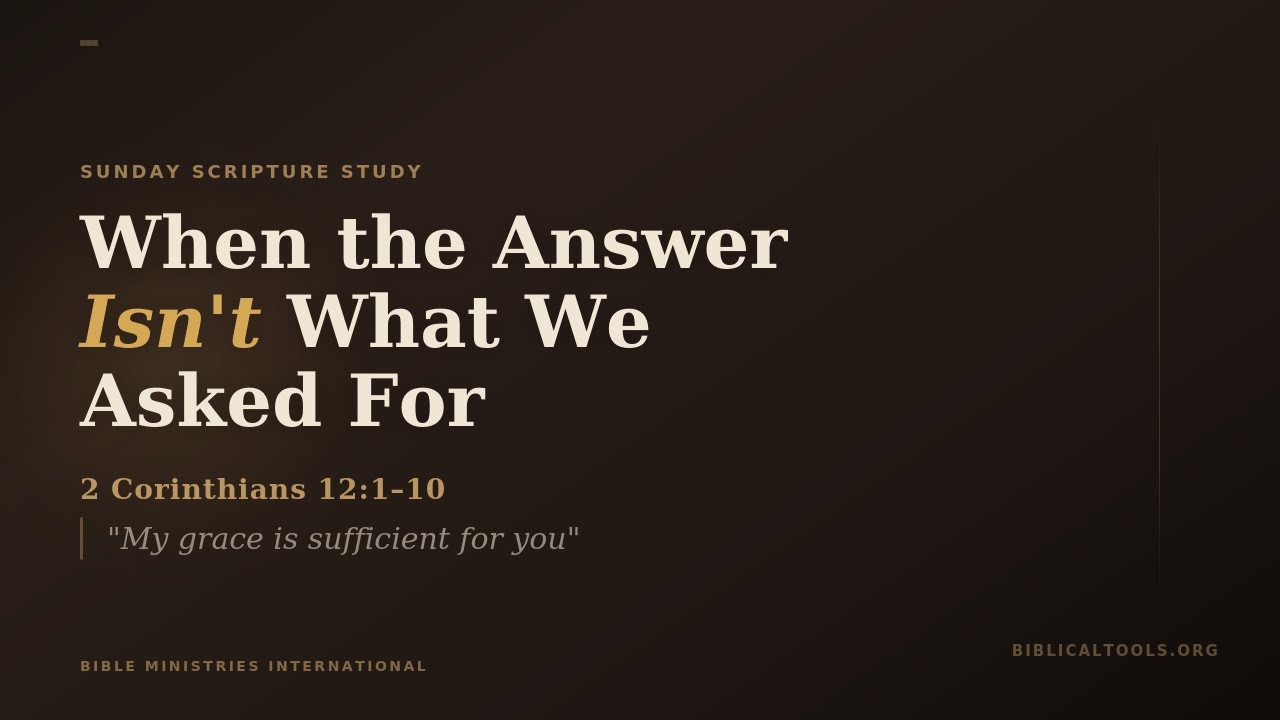
Study #7 — Series 3: "Finding Strength and Purpose." Paul asked three times for God to remove his thorn in the flesh. The answer that came back wasn't removal — it was, "My grace is sufficient for you." What do we do when the miracle we're praying for doesn't come? This study looks carefully at what actually changes in the passage — and what doesn't. Includes a word study on sufficient using the Hebrew behind the Greek (TWOT 2099) and the supporting witness of Hebrews 11:35–40, where many faithful "did not receive the promise" in this life. Sometimes grace meets us in the unanswered places — not by removing the thorn but by making us aware that something else is operating. Next week: The Hard Work of Forgiveness.
2 Corinthians 12:1–10, Hebrews 11:35–40
Study #6 — Series 3: "Finding Strength and Purpose." A Resurrection Day study tracing how sorrow and joy actually appear together across Scripture. Psalm 30:5 states a sequence — weeping in the evening, a ringing cry of joy in the morning — but does not tell us how long the evening lasts. Psalm 42:5 shows someone cast down even while speaking to his own soul. Job 13:15 — with its striking ketiv/qere variation (לֹא / לוֹ) — places yakach (to reason, argue, present a case) alongside "I will not wait," still engaging God even without clear hope. Joseph in Genesis 50:20 understands "what God meant for good" only after the pit, the slavery, the prison. And Hebrews 12:1–2 speaks of joy set before Christ — not joy during the cross itself. Joy is stated; sorrow is ongoing; understanding may come later; sometimes joy is set before us, not yet visible. Next week: When the Answer Isn't What We Asked For.
Psalm 30:5, Psalm 42:5, Job 13:15, Genesis 50:20, Hebrews 12:1–2
Study #5 — Series 3: "Finding Strength and Purpose." After last week's Psalm 13 — where the text never explains how David moved from complaint to "I have trusted in your mercy" — Psalm 62 doesn't define trust either. It observes it. The words only and alone repeat across verses 1, 2, 5, and 6, narrowing the focus to one place. The Hebrew behind silent carries the idea of stillness, waiting, quiet resting (see also Psalm 65:1). The pressure doesn't lift — David is still "a wall stretched out, a fence being thrust down" — but the focus keeps returning. Verse 8 places two commands side by side: Trust (TWOT 233 — security, settled confidence) and pour out your heart (TWOT 2444). Trust here is not only silence but also openness. Seven times David names God personally — rock, salvation, strong tower, refuge. The psalm ends with who God is, not with a changed situation. Next week: Finding Joy in Sorrow.
Psalm 62, Psalm 13:5, Psalm 65:1, Deuteronomy 33:28
Study #4 — Series 3: "Finding Strength and Purpose." Not an attempt to answer why God seems silent — but to look at how the Bible actually describes that experience. Psalm 13's four "until when" statements build from God's seeming absence to internal struggle to outward pressure. The Psalm moves from complaint to request to trust — but the text never explains how David got from verse 2 to verse 5. The same tension appears in Habakkuk 1:2 and Job 30:20. Scripture records the experience of God seeming silent honestly — without smoothing it over or immediately explaining it. Next week: Study #5 — Learning to Trust Again.
Psalm 13:1–6, Psalm 22:1, Habakkuk 1:2, Job 30:20, 1 Samuel 30:6
Study #3 — Series 3: "Finding Strength and Purpose." What happens when pain turns inward? The Hebrew word rosh traces from Deuteronomy 32:32 through Jeremiah to Psalm 69:21 — where it becomes messianic: the gall offered to Christ on the cross.
Hebrews 12:10–17, Deuteronomy 32:32, Psalm 69:21
Study #2 — Series 3: "Finding Strength and Purpose." Full study of Psalm 139:13–18. Where does human worth come from? Not from accomplishments, approval, or comparisons — Scripture points to something deeper: how God regards human life. David describes God actively forming life in the womb — "You wove me in the belly of my mother" — and knowing every day before it unfolds. The Hebrew word golem (embryo) appears only once in the entire Old Testament, right here. David's response is not "I am marvelous" but "Your works are marvelous" — the focus remains on what God has done. Explores Hagar in Genesis 16, who even in rejection said God was "the One seeing me," and Psalm 8's paradox: human beings are fragile and limited, yet God is mindful of them. Includes word study on the Hebrew root behind "wonderfully" (TWOT #1768) — the same family used in Isaiah 9:6 for "Wonderful, Counselor." Next week: Study #3 — Turning Bitterness Into Blessing.
Psalm 139:13–18, Jeremiah 1:5, Genesis 16, Psalm 8:3–4, Isaiah 9:6, 1 Corinthians 6:20
Study #1 — Series 3: "Finding Strength and Purpose." Full study of 2 Corinthians 12:1–10. Where does strength come from when we truly have nothing left? Paul received extraordinary revelations — then a thorn in the flesh to prevent exaltation. The Greek skolops (stake, splinter) describes something sharp, painful, and persistent. Paul entreated the Lord three times. God's answer: "My grace is sufficient for you, for My power is perfected in weakness." Weakness in Scripture — astheneia — is not moral failure but depletion, limitation, human frailty. When Paul reaches the end of himself, something else operates. Explores the goads of Acts 26:14 (Hebrew dorbān), Psalm 73:25–26, and Habakkuk 3:19. True strength is not self-sufficiency — it is God-sufficiency. Includes Hebrew and Greek word studies from TWOT and Margoliouth.
2 Corinthians 12:1–10, Ezekiel 2:6, Jeremiah 38:4, Acts 26:14, Psalm 73:25–26, Habakkuk 3:19
Study #10 — Phase 2: "Navigating Specific Struggles." Full chapter study of Jeremiah 20:7–18. A faithful prophet accuses Jehovah: "You have deceived me; yea, I was deceived." He decides to go silent — "I will not mention him or speak anymore in his name." And cannot. "His word was in my heart like a burning fire, shut up in my bones, and I was weary of holding in, and I was not able." Explores the internal place that says "I don't want to keep doing this" — and what Scripture says about endurance that is not mere willpower. The passage moves from accusation to praise to lament within eighteen verses: one of the most honest portraits of faith in all of Scripture. Also introduces a new 50-part audio series: Reading Scripture Clearly — Episode 1 now available at BiblicalTools.org.
Jeremiah 20:7–18, Romans 8:26–27, Psalm 22:1–2
Study #19 — Phase 2: "Navigating Specific Struggles." Full chapter study of 1 Samuel 24: David spares Saul in the cave at En Gedi. Do we fear God more than we fear being misunderstood? David had every right and opportunity to kill Saul but cut only his robe—then his heart struck him even for that. Explores refusing to take vengeance into your own hands, trusting God as judge ("Jehovah shall judge between you and me"), maintaining respect even for those who wrong you, and the internal battle of restraint when everyone says "take the shot." The real battle with difficult people is internal, not external. Features community discussion on carrying burdens while navigating difficult relationships.
1 Samuel 24, Psalm 142, Romans 12:17-21, Proverbs 25:21-22, Matthew 5:44
Phase 2: "Navigating Specific Struggles." When marriage breaks down through betrayal, emotional distance, addiction, or years of accumulated hurt—where do we turn? Examining biblical patterns of covenant faithfulness through Hosea's radical love for unfaithful Gomer, God's pursuit of wayward Israel, and Christ's self-sacrificial love for His bride. Explores reconciliation versus enabling, forgiveness that doesn't require restoration, holding boundaries while keeping hearts open, and trusting God through seasons when marriage feels impossible. Features discussion on the difference between biblical submission and enabling abuse, practical steps for protecting yourself while praying for restoration, and finding hope when outcomes remain uncertain.
Hosea 1-3, Ephesians 5:22-33, 1 Corinthians 7:10-16, Matthew 19:3-9, Malachi 2:13-16
Phase 2: "Navigating Specific Struggles." When children break our hearts through rebellion, estrangement, addiction, or mental illness, where do we turn? Examines the father of the prodigal son (Luke 15) exemplifying love that waits—watching the road with longing but respecting agency, unable to control the son's heart but controlling his own by keeping it open. Hannah (1 Samuel 1-2) models love that surrenders—releasing Samuel to God's purposes through her prayer and song of trust. Together they reveal faithful parenting: love that waits without controlling, love that surrenders what we cannot fix, trusting God through the long heartache. Features deeply personal family stories (son's suicide, daughter with schizophrenia), Rembrandt's "Return of the Prodigal Son" painted after burying wife and four children with only his worn Dutch Bible remaining, and extensive Q&A on trusting God's timing, processing grief, and finding hope when parenting outcomes aren't what we prayed for.
Luke 15:11-24, 1 Samuel 1:9-11, 1 Samuel 2:1-10, 2 Corinthians 4:16, Proverbs 22:6
Phase 2: "Navigating Specific Struggles." Examining four biblical accounts of illness. Epaphroditus: mercy in weakness (Philippians 2:25-27) - faithful servant nearly dies, Paul grateful for God's mercy not just on Epaphroditus but himself, showing faithfulness doesn't guarantee health. Trophimus: faith amid unresolved sickness (2 Timothy 4:20) - Paul leaves trusted co-laborer sick in Miletus, apostles faced unanswered prayers, burdens remain for deeper purpose. Crippled woman: chronic suffering never cancels worth (Luke 13:10-17) - 18 years bent, still in synagogue, Jesus affirms her as daughter of Abraham before physical healing, identity secure in Christ. Hezekiah: healing calls for humility (2 Kings 20:1-11) - given 15 years but pride creeps in, healing not end of spiritual formation. Features personal testimony about friend Paul with Lewy body dementia, figs' healing compounds, and extensive Q&A on truth (emet), Hebrew graphemes, resurrection, bones symbolism, and God's preservation of Scripture.
Philippians 2:25-27, 2 Timothy 4:20, Luke 13:10-17, 2 Kings 20:1-11, 2 Corinthians 4:16, Psalm 73:26
Phase 2: "Navigating Specific Struggles." Examining God's provision through the widow of Zarephath. Zarephath means "refining place" - both Elijah and widow refined by dependence, not judgment. Explores how crisis doesn't mean God's absence, divine direction arriving within crisis not before it, God choosing unlikely people (vulnerable widow) to sustain His prophet, the widow's handful of meal and little oil becoming daily sufficiency. Features Hebrew word studies on "sustain" (kûl), God causing humbling/hunger/manna (Deuteronomy 8:3), multiplication principle (five loaves), and God's provision being adequate not abundant. Extensive Q&A on Zarephath as testing/refining, Hebrew word families, manna pointing to Christ, sticks representing tribes, and living in the moment.
1 Kings 17:8-16, Matthew 6:24-34, Zechariah 13:9, 1 Peter 1:7, Philippians 4:11-13, Deuteronomy 8:3, John 6:5-14
Phase 2: "Navigating Specific Struggles." Examining Peter's denial and restoration. Some mistakes alter life's direction, others leave scars time can't erase. Through Luke 22, discovers that sin often begins with distance - Peter follows afar off, sits among Christ's enemies, then denies Him three times. Yet Jesus turns and looks at Peter with eyes of flame - holy love that brings conviction. Peter's bitter tears led to restoration. Explores the difference between godly sorrow (2 Corinthians 7:10) and worldly regret, Judas vs Peter, Jesus praying for Peter before his failure. Features discussion on self-forgiveness, Esau's tears without repentance, and applying truth: failure isn't final when grace is real.
Luke 22:54-62, John 21:15-17, Psalm 51:1-12, 2 Corinthians 7:10, Micah 7:8-9
Phase 2: "Navigating Specific Struggles." Exploring Jacob's decades-long grief over Joseph and what Scripture teaches about sorrow that refuses to leave. Through Genesis 37 and 45, discovers that Jacob refused to be comforted - not rebellion, but love remembering. His grief is faith's silence, not faith's absence. Examines the Hebrew word "nakam" (comfort/sigh), how God's faithfulness doesn't depend on our feelings, grief needing presence not pressure. Features discussion on the received text, translation principles, and Hebrew word studies.
Genesis 37:31-35, 45:26-28, 47:9, Hebrews 11:8-13, Psalm 42:3-5, Jeremiah 31:15-17
Phase 2: "Navigating Specific Struggles." Examining anxiety through Elijah's experience under the juniper tree where fear and exhaustion drove him to despair. Explores the physiology of anxiety, how God addresses both body and soul, and practical steps for managing overwhelming worry. Features the Hebrew word "yare" (fear), discussion of Philippians 4:6-7, casting cares on God, and the difference between godly concern and destructive anxiety.
1 Kings 19:1-18, Philippians 4:6-7, Matthew 6:25-34, 1 Peter 5:7, Psalm 94:19
Eleventh session examining how Scripture addresses the weight of life pressing us down. Through Elijah's story after Mount Carmel, we explore God's tender care in human collapse, the pattern of despair following victory, God's provision of rest and food before addressing spiritual needs, and the still small voice that speaks in our darkest moments. Depression is not disqualification - it's often where God meets us most intimately.
1 Kings 19:1-18, Psalm 42:5-11, Lamentations 3:17-26, 2 Corinthians 1:8-10
Tenth and final session in God's Heart for the Hurting series. Explores renewal through ordinary providence in Ruth's story and personal encounter in Mary Magdalene's experience. Examines how God turns endings into beginnings, the pattern of loss giving way to presence and renewal, and discovering that faithfulness in the ordinary is the soil of new beginnings.
Ruth 1-2, John 20:1-18, Isaiah 43:18-19
Ninth session exploring the unique pain when relationships end despite faithfulness. Examines the man born blind who was cast out for telling truth (John 9), understanding what is and isn't our responsibility when fellowship is lost, living with relationships that may never be restored, and discovering Christ's intentional pursuit when human fellowship ends. Features discussion on forgiveness without reconciliation, the difference between faithfulness and failure, and practical guidance for processing relational loss while maintaining faith.
John 9:1-38, Romans 12:18, 1 Peter 2:23
Eighth session addressing the hardest question: Why? Why did this happen? Why is God allowing this? Explores trusting God's character when His plan makes no sense, viewing the Prodigal Son parable from the father's perspective, and learning to hold both devastation and trust simultaneously.
Luke 15:11-20, Proverbs 3:5-6, Isaiah 55:8-9
Seventh session exploring the exhaustion that comes from long seasons of suffering and what Scripture teaches about God's rest. Examines the difference between physical rest and soul rest, how to find restoration when you're too tired to keep going, and Christ's invitation to the weary and heavy laden.
Matthew 11:28-30, Psalm 23, Hebrews 4:9-11
Sixth session exploring peace when the storm doesn't end. Distinguishes between peace and numbness, surrender and resignation. Examines what happens when storms last years or decades, how to find God's presence in ongoing pain, and the difference between the world's peace and Christ's peace that surpasses understanding.
Mark 4:37-40, John 14:27, Philippians 4:6-9
Fifth session addressing the exhaustion of praying repeatedly with no visible results. Explores honest anger at God, the difference between God's will and what He allows in a fallen world, surrender without immediate relief, and learning to pray persistently while trusting God's timing even when the answer is no.
Job 30:20, Luke 22:42, 2 Corinthians 12:7-9
Fourth session exploring how God's love remains constant regardless of our feelings. Examining what Scripture teaches about the difference between knowing God loves us intellectually versus feeling His love experientially.
Romans 5:8, 1 John 4:9-10
Third session exploring what happens when multiple devastating losses hit simultaneously—examining Job's total collapse and discovering hope that survives even when everything falls apart. Covers being known by God as His workmanship, practical steps for surviving compound crises, and extensive Q&A on biblical interpretation, the transfiguration, Reuben's sin and redemption, spirits in prison, and finding reconciliation in difficult scriptural passages.
Job 1:14-19, Jeremiah 1:5, Ephesians 2:8-13
Second session exploring the painful but liberating truth that living faithfully doesn't guarantee protection from life's hardships. Through personal vulnerability about family struggles, we discover why even the most godly people face persecution and suffering.
2 Timothy 3:10-12
Introduction to our series exploring the biblical reality of feeling forsaken, examining the honest cries of both King David and Jesus Christ. Features extensive Q&A on God's sovereignty, biblical study methods, and finding hope in spiritual dryness.
Psalm 22:1-2, Matthew 27:46
Review key concepts from our Sunday Bible Study sessions with interactive flashcards. Perfect for deepening your understanding and preparing for upcoming discussions.
Click the card to flip between questions and answers, or use the arrow keys to navigate.
You Matter to God in Your Pain
Episodes 1-10
Practical Biblical Help for Real Problems
Episodes 11-20
God's Power in Your Weakness
Episodes 21-30
Becoming Who God Wants You to Be
Episodes 31-40
A Future and a Hope
Episodes 41-50
All are welcome. Come as you are, with your questions, struggles, and hopes. This is a safe space to be honest about your pain while finding biblical truth that brings real comfort.
Every Sunday includes a open forum where you can ask biblical questions related to your struggles. Here are some common questions from hurting people and pastoral responses.
Questions are reviewed and may be addressed in upcoming sessions.