
What We Believeand how we read the Bible
We hand out no creeds, confessions, or statements of faith. Instead, we encourage everyone to examine the Scriptures for themselves, as the Bereans did in Acts 17:11. This page explains what we believe about the Bible, the texts we work from, and how anyone can test these convictions against Scripture.
01 · Our foundation
The Bible is the Word of God, and it is true.
We believe the Bible is the Word of God. We invite everyone to examine what we teach against the Scriptures themselves.
The sum of Your Word is true; every one of Your righteous judgments endures forever.
02 · Our approach
We read it the way the Bereans did.
And these were more noble than the ones in Thessalonica, who received the Word with all readiness, according to a day examining the Scriptures if these things might have been so.
We want to consider every verse in the Bible with humility and patience. In light of Acts 17:11 and 1 Corinthians 2:13, our aim is to approach Scripture without preconceived ideas or bias of any kind, “comparing spiritual things with spiritual things” (1 Corinthians 2:13).
The text beneath it all
The first Bible version (its translator Jay P. Green, Sr. wrote) to contain “all of God’s words, as He wrote them, with no words added, and no words deleted.”
Working from the original Hebrew and Greek, he restored what centuries of translation had smoothed away — thousands of words, set right one at a time. It is the same text that runs through every tool on this site.
Four restorations
Four of thousands — shown here; the same care runs through all sixty-six books.
The Translator’s Foreword
Before you read
his foreword
Jay P. Green, Sr., wrote his own foreword for the KJ3. It follows below, reproduced in full — typographical slips lightly corrected, his words otherwise untouched. First, a word from Bible Ministries International on what the work of translation can and cannot be.
As you will see, Jay Patrick Green, Sr., was a man passionate about his work. You will meet strong words in his pages — about other versions, and about the people who made them. Those judgments are his, carried from the battles of his day.
No translation is ever one for one. On the first page of Scripture, “God saw the light, that it was good” — the word is טוֹב, tov. But tov carries more than our “good” can hold: pleasing, beautiful, right, as it should be. The translator must set one English word in its place, and leave the rest behind. A language holds its meanings inside the group that speaks it; what we say, and what we write down, is an expression of how we think — as individuals, and as people together. Those whom God used to write His words stood far from us geographically, and farther still in time. They spoke and wrote from inside their own world. To live in the modern world, using a language relatively new, and reach back into an ancient language no longer spoken, is a task that can only ever approximate.
What we have today is remarkable: copies of the original manuscripts in Hebrew, Greek, and Aramaic, gathered and kept together. But we are not thinkers, speakers, or writers of those languages that God used to record His word. We can only ever approximate their meaning in the work of translating them.
So we should never be so bold as to say that any translation is divine — only that we gave it our all to be as faithful as is possible in our work to God.
It is good to weigh translations carefully. But differences among Christians need not divide us; we would rather they draw us deeper into the Word, together.
And this we maintain at Bible Ministries International: though there are many brands of Christianity, there is only One Christ.
So we seek to act as a bridge to others, never as a roadblock. Otherwise we perpetuate the fragmented Christian world, and we cannot follow the commandment to love our neighbors — to find a way to meet people wherever they are, as the ministry of Jesus Christ did.
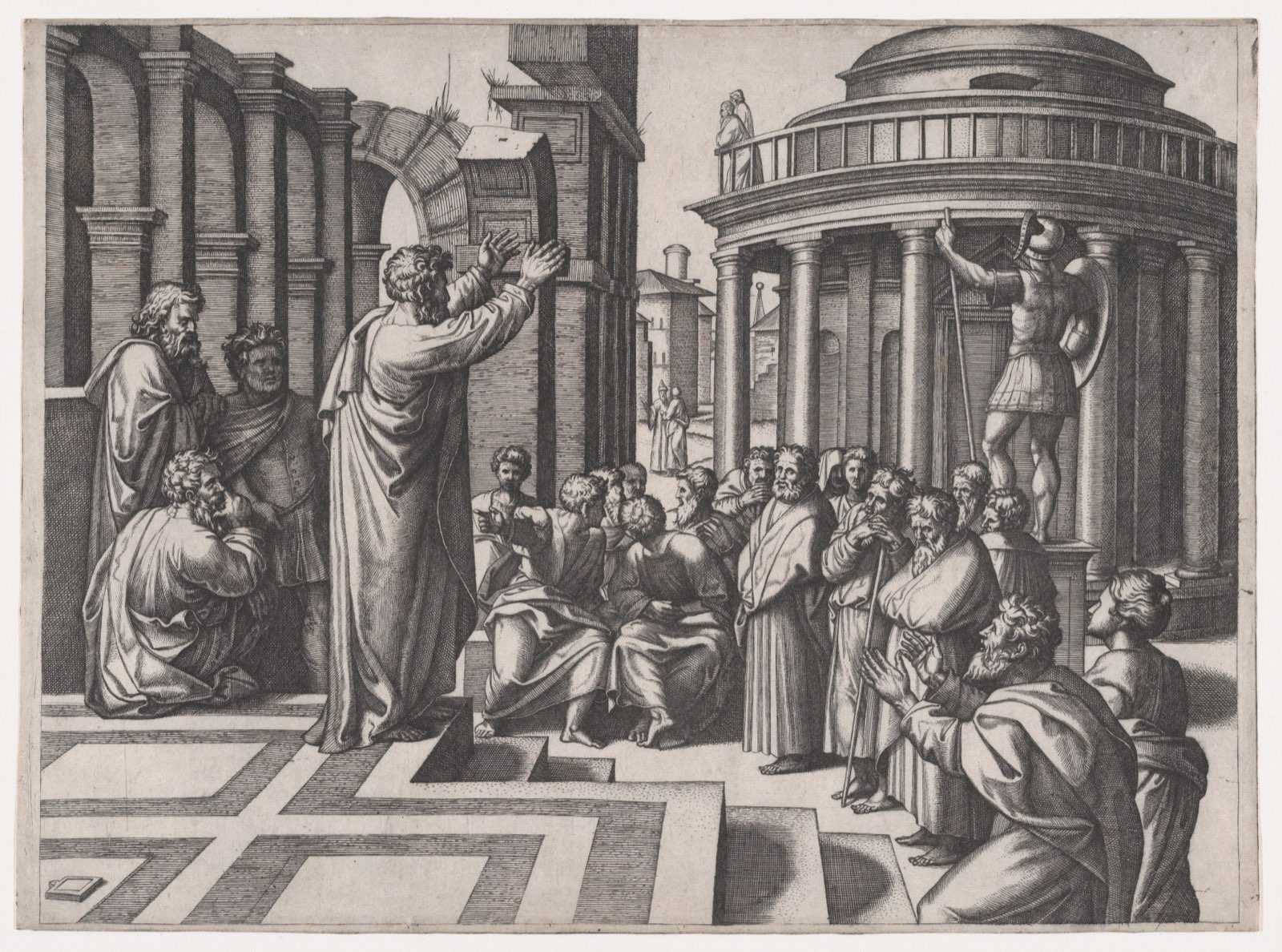
SAINT PAUL PREACHING IN ATHENS · after Raphael / Marcantonio Raimondi · The Metropolitan Museum of Art
The LITV, published by Sovereign Grace Publishers as the KJ3
This is the translation that appears in the side margins of Jay P. Green, Sr.’s best-selling series of The Interlinear Hebrew-Greek-English Bible. This is the fourth edition of this most accurate of all versions. Due to additional intense study, and the suggestions of others, we feel confident that this version has now been perfected.
The difference between the KJ3 Bible and all other English versions ever created in the past is this: This is the first time that any version has contained all of God’s words, as He wrote them, with no words added, and no words deleted. Note that God has commanded this several times. See Deuteronomy 4:2. KJ3/LITV: “You shall not add onto the Word I command you, neither shall you take away from it, to keep the commandments which I have commanded you.” (Deuteronomy 12:32; Proverbs 30:6; Revelation 22:18–19.) When a version adds words to the words that God breathed out or fails to translate what God has written, and hides from the reader what they have added or subtracted from God’s word, they are deceiving the reader by in effect saying, “These are the words that God wrote,” when the truth is that God did not write many of the words that they have put into their Bibles.
Continue reading — the foreword in full
This is especially grievous in the Bibles like the NIV that use “Dynamic Equivalence” as their translation methodology. Basically, “Dynamic Equivalence” is storytelling or a short commentary of what God has breathed out to us. The alleged translator reads a passage of the Bible in its native language (Greek or Hebrew), perceives or interprets the meaning, and writes in his own words what the alleged translator believes the Bible is saying. There is no effort to translate each word of the Hebrew or Greek. For example, the translator “uses the Greek genitive-case form with the corresponding use of the English preposition ‘of’ to illustrate how to eliminate ambiguities. ‘Cup of the Lord’ (1 Corinthians 10:21) is rendered ‘the cup by which we remember the Lord,’ ‘wisdom of words’ (1 Corinthians 1:17) is taken to be ‘well arranged words,’ and ‘sons of wrath’ (Ephesians 2:3) becomes ‘those with whom God is angry’” (Nida, Toward a Science 207–208; cf. also Nida and Taber, The Theory 35–37; Wonderly, Bible Translations 163). This is directly from the works that our seminaries are using in teaching our future Christian leaders, pastors, professors, headmaster, teachers, et al. We are not talking about the luke-warm religions or the luke-warm seminaries, but rather virtually every seminary in the free world has been infected with this rationale.
It is the modern world Pharisees and Scribes at work. Only they may interpret what the Word of God truly states and then they tell us in their own words. Martin Luther would roll over in his grave. He and our other forefathers fought to bring the Word of God out of the priests’ and monks’ hands directly to the hands of Christ’s flock. Now our modern day Pharisees and Scribes are trying to take the Word of God back away from that flock. Kid yourself not, this is a Holy War we are fighting.
The amazing thing is how many sound Christian leaders have fallen for this rationale. We have not been able to discern whether they just don’t know any better, haven’t had time to investigate these translations, or what other reason they continue using the NIV. But the NIV has penetrated and been accepted by some very good churches with pastors sound in every area except the use of God’s text. The whole foundation of Christianity lies in the Bible and what God has written to us. If we can’t trust that, then what can we trust. Another example of this mistranslation is found as follows: Jesus said to his brothers, “I am not yet going up to the feast, for my time has not yet been fulfilled.” (John 7:8) Despite the overwhelming evidence of all but two Egyptian manuscripts, the New Versions follow the Gnostic Egyptian codices which deliberately remove the word “yet” leaving Jesus saying “I am not going up to the feast.” In the first example, Jesus says that I am not going to the feast yet, which implies that he will be going to the feast later. In the second example, Jesus will not be going to the feast at all. This makes Jesus lie to His brothers. But Jesus is God, and “It is impossible for God to lie” (Hebrews 6:18). It is just one more way to deny that Jesus is God.
This new KJ3 version is the version that lovers of God and His Word can safely use with the approval of God. You and every person will be judged by ALL of the words that God has written. Add to this, that God wrote in grammatical forms (nouns, verbs, adjectives, adverbs, etc.). Our Lord Jesus was always careful to keep the grammar of the Old Testament words He quoted in the New Testament. No other Bible version has ever strictly given the reader these grammatical forms as God has written them. In all other versions printed before there is a consistent failure to report to the reader the precise use of these word forms (verbs have been falsely translated as nouns, and vice versa; adjectives have been largely ignored; when reported the previous translations do not tell the reader whether they are plural or singular. Hundreds of adverbs have been inserted which are not in the original Greek or Hebrew words.
When a verse contains two verbs, invariably they falsely add an adverb, saying “you shall surely die”, but there is no adverb in the Hebrew here, but correctly translated it says “Dying you shall die”. Hundreds of times the other translations mistranslate “seed” as offspring or other plurals. Verses containing double negatives (not, not) have been mistranslated by inserting words that falsely translate one of these emphatic words such as “By all means”; or, “not at all” words that are not in the Greek, or they will not translate the second negative (“not, not”). In an attempt to avoid the English rule that two negatives make a positive. But there is a way to avoid this violation: e.g. “And the light of a lamp will not still shine in you, not ever” (Revelation 18:23); using both “nots.” In Isaiah 24:19 there are four verbs that need no added words, but the New Versions do it anyhow: NIV: “The earth is utterly broken up, the earth is [split asunder], the earth is [thoroughly shaken]. The earth [reels] like a drunkard . . . .” The adverbs are added without cause. KJ3/LITV: “The earth is breaking, breaking! The earth is crashing, crashing! The earth is tottering, tottering! The earth is staggering, staggering; like a drunkard the earth is staggering.” The worst mistranslations: “Lord” for the divine name (“I am Jehovah, that is my name,”). God’s name is mistranslated more than 6,000 times.
Every nation had their lords, but only Israel had Jehovah as their God. All other countries were “the nations.” In the New Testament “Gentiles” is falsely put for the “nations.” “Church” is a word God never wrote: instead he called the meeting place “the assembly” both in the New and Old Testament. “The children of Israel” never existed as such, for the word, for “sons” is badly translated as “children.” In many versions this occurs more than 500 times. Dead is either an adjective (“dead ones”) or a verb (“to die”), (e.g. “he has died”). Also (“put to death”) is from this verb, and most often translated as “cause to die”. Usually, with most translations which have the same verb twice, one of the verbs will be replaced with an adverb. Charles Spurgeon had the following to say about translation:
“Concerning the fact of difference between the Revised and Authorized Versions, I would say that no Baptist should ever fear any honest attempt to produce the correct text, & an accurate interpretation of the Old/New Testaments. For many years Baptists have insisted upon it that we ought to have the Word of God translated in the best possible manner, whether it would confirm certain religious opinions and practices, or work against them. All we want is the exact mind of the Spirit, as far as we can get it. Beyond all other Christians we are concerned in this, seeing we have no other sacred book; we have no prayer book or binding creed, or authoritative minutes of conference — we have nothing but the Bible — and we would have that as pure as ever we can get it. By the best and most honest scholarship that can be found we desire that the common version may be purged of every blunder of transcribers, or addition of human ignorance, or human knowledge, that so the Word of God may come to us as it came from his own hand.”
— Charles H. Spurgeon · Heart-Disease Curable, MTP Vol. 27 (1881)
Only by going back to each and every word of the Hebrew and Greek manuscripts can we ever attempt to have the pure translation that Charles Spurgeon above desires. This is what we have tried to do with the KJ3 – Literal Translation of the Bible.
His last work
He finished it two weeks before he died — at which time he stated, “It is finished.”
Jay P. Green, Sr. · 1918 – 2008

THE PROPHETESS HANNAH · Rembrandt, 1631 · Rijksmuseum, Amsterdam
More than six thousand times
Read exactly as the Hebrew text is pointed, the name is Jehovah — and the KJ3, being literal, prints it every time it stands: more than six thousand places where most Bibles print “the LORD.”
See it stand in Isaiah 42:8In the interest of full transparency
A Note on the Name
Jehovah, “the LORD,” and Yahweh — three honest answers, and why the KJ3 prints the first.
Jehovah
Read the pointing literally.
The four graphemes exactly as they are pointed, carried through Latin into English. The KJ3 prints it wherever the Name stands.
“the LORD”
Read it as the scribes intended.
The marks beneath the Name, in that tradition, carry the vowels of Adonai — a standing cue: say “Lord.” Most English Bibles print it.
Yahweh
Reconstruct the sound behind it.
Careful scholarship reasoning back toward a likely sound — a reconstruction of a pronunciation that was never written down.
Read the full note — as printed in The Offerings
Somewhere in the Hebrew Old Testament stands the name the scribes guarded above all others: four consonants, יהוה, the personal name of God. What an English Bible prints where those four graphemes fall is not a simple matter of one word being right and another wrong. It is a matter of which layer of the text one reads from — and how far one follows it. Three answers have come down to us, and it is worth seeing how each is reached.
The Hebrew we read today is a pointed text — most often the Leningrad Codex, the oldest complete manuscript of the Hebrew Bible, and the one available to us in a form a computer can read, so that we can display it on our platform. Beneath and beside its consonants sit small marks — a whole apparatus alongside them. Read the four graphemes of the Name exactly as they are pointed, and carry that reading through Latin into English — where the Hebrew Y becomes J and the W becomes V — and you arrive at Jehovah. The KJ3, being a literal translation, prints it wherever the Name stands: more than six thousand times, in the places most Bibles print “the LORD.” The King James Version is one of them, printing “the LORD” almost everywhere the Name stands — and yet even the King James keeps it as Jehovah in seven places of its own.
But the same marks can be read a second way. According to the scribal tradition, the Name was too holy to be spoken aloud — never to be taken in vain — so the scribes read another word in its place: Adonai, “Lord.” The marks the text sets beneath the Name are, in that tradition, not the Name’s own vowels but the vowels of Adonai — a standing cue to the reader: do not pronounce this; say “Lord.” Follow that cue as the tradition intends, and you arrive at “the LORD,” which is what most English Bibles print.
The four consonants on their own, stripped of any pointing, cannot be pronounced with certainty; no one alive has heard them said as they were said in the days of Moses. Scholars have reasoned back toward a likely sound, and it is from that reconstruction that the form Yahweh comes. It is careful work — but it remains a reconstruction, an estimate of a pronunciation that was never written down.
The line between the pointed text and the unpointed text should be kept very clear, for everything turns on it. A Hebrew speaker in the days of the Bible needed no points to read; the sound of the words lived in the mouths of those who spoke the language. The points, scholars hold, came only centuries later — added, on the usual account, as living Hebrew faded, so that the reading tradition would not be lost. To read the pointing literally is one honest thing; to read it as the scribes intended is another; to reconstruct the sound behind it is a third. Jehovah, “the LORD,” and Yahweh are not three rival truths. They are three honest answers to three different questions.
And there are more layers than two. The Leningrad Codex is, so far as the manuscripts go, the oldest complete Hebrew Bible we hold — but not the oldest witness. The Aleppo Codex is older still; and other schools of scribes, scholars tell us, once pointed the text by rival systems altogether, their marks set above the letters rather than below. Beneath all pointing, scholars hold, lies a far older consonantal text — one the Dead Sea Scrolls carry a thousand years earlier, and one the Greek Septuagint was translated from before that. On their account, the pointing is the newest layer on a text that was copied, and guarded, long before anyone set down a single mark of it.
We do not set down these pages to settle the matter. Bible Ministries International exists to be transparent about it. We begin where the received text begins — with the pointed Hebrew of the Leningrad Codex, because that is the form we can hold in a computer and a reader can check for himself. Jay P. Green translated it literally and with great diligence; that is a discipline, not a claim to have recovered a lost sound. Where he prints Jehovah, he is reading the pointing exactly as it stands — and telling you so.
For translation can only ever be an approximation. English did not exist when the Scriptures were written; no one today speaks, writes, or fully hears the Hebrew and Greek of that age as its first hearers did. Every version is a hand reaching across a distance of language and of centuries. The honest thing is not to pretend the distance away, but to show it — to let the reader see the seams.
And the Name is only one of many by which Scripture calls upon God — a Hebrew word whose ancient pronunciation no one now knows for certain. That uncertainty has never stopped anyone from calling upon Him, or reading His Word.
The marks the pointed text carries — beneath, beside, and around the graphemes
Vowel points niqqud
The dots and strokes that supply the vowels — set underneath, above, and within the consonants.
Accent marks te’amim
Cantillation that also fixes stress and phrasing — where a sentence breaks, which can change its meaning.
Other diacritics
Dagesh, mappiq, meteg, maqaf, and more — small marks that harden a letter, join words, or steady the voice.
The Masorah
Marginal notes counting the letters and words, flagging variants, and the qere/ketiv — “read” versus “written” — the very cue that set Adonai’s vowels on the Name.
Every name is a symbol. It points toward something, but it is never the thing it points to. The menu is never the meal.
05 · The texts we stand on
We work from the languages the Bible was written in.
Every study begins with the text itself — the Hebrew of the Old Testament and the Greek of the New. These are the texts behind everything we teach and everything on this platform.
Hebrew Old Testament
The Bomberg–Ginsburg Text
The Masoretic Text as printed in the second Rabbinic Bible — published by Daniel Bomberg in Venice, 1524–1525, edited by Jacob ben Chayyim. In the nineteenth century Christian David Ginsburg refined it against additional manuscripts. This is the Hebrew behind the KJ3 Literal Translation.
Venice, 1524–1525
Hebrew on screen
The Leningrad Codex
The oldest complete manuscript of the Hebrew Bible, and the one available in a form a computer can read. The pointed Old Testament Hebrew you see in our study tools comes from this codex — so that a reader can check every word for himself.
The oldest complete Hebrew Bible we hold
Greek New Testament
The Textus Receptus
The Received Text of the Greek New Testament, in the tradition begun when Desiderius Erasmus compiled the first published Greek New Testament in 1516, carried through the Stephanus and Elzevir editions. The KJ3 uses Scrivener’s 1894 edition.
Tradition from 1516 · Scrivener 1894
06 · Working from the text
The tools we study with.
We use these Bible study tools together, with the aim of teaching others how to approach any verse in the Bible.
The translation
KJ3 Literal Translation
Jay P. Green’s literal English translation, valued for its consistent, word-for-word renderings of the Hebrew, Aramaic, and Greek. The complete KJ3 — all 66 books — is free to read in our Bible Reader.
Word study
Theological Wordbook of the Old Testament
Rather than relying on Strong’s numbers, we work with the TWOT — the standard scholarly reference for Hebrew semantic ranges — to study Hebrew and Aramaic words in their word families.
Hebrew New Testament
Salkinson–Ginsburg Hebrew New Testament
A literary Hebrew translation of the New Testament begun by Isaac Edward Salkinson (1820–1883) and completed after his death by the Masoretic scholar Christian David Ginsburg. Published in 1886, it renders the New Testament as native Hebrew literature, echoing the style of Moses and the Prophets.
Published 1886
Hebrew New Testament
Margoliouth’s Hebrew New Testament
Translated by Ezekiel Margoliouth (1846–1924), this is the only fully cantillated Hebrew New Testament — all 7,948 verses preserved with full vowel pointing and cantillation marks. We use it as a bridge between the Old and New Testaments.
The only fully cantillated Hebrew NT
These tools serve the study of Scripture; they do not replace reading and examining the text for yourself. Both Hebrew New Testaments — and the Greek — can be opened verse by verse in the Bible Reader and on our Hebrew New Testament page.
Try it here
One verse, four renderings.
John 1:14, exactly as it stands in the Reader — the same texts, the same toggles.
And the Word became flesh and tabernacled among us. And we beheld His glory, glory as of an only begotten One from the Father, full of grace and of truth.
και ο λογος σαρξ εγενετο και εσκηνωσεν εν ημιν και εθεασαμεθα την δοξαν αυτου δοξαν ως μονογενους παρα πατρος πληρης χαριτος και αληθειας
וְהַדָּבָר לָבַשׁ בָּשָׂר וַיִּשְׁכֹּן בְּתוֹכֵנוּ וְאֶת־כְּבוֹדוֹ רָאִינוּ כִּכְבוֹד בֵּן יָחִיד לְאָבִיו מָלֵא חֶסֶד וֶאֱמֶת
וְהַדָּבָ֞ר הָיָ֤ה לְבָשָׂר֨ וְשָׁכַ֣ן בְּתוֹכֵ֔נוּ וְרָאִ֨ינוּ֨ אֶת־כְּבוֹד֔וֹ כָּב֛וֹד כַּֽאֲשֶׁ֥ר לְיָחִ֖יד הַנּוֹלָ֣ד מִן־הָאָ֑ב מָלֵ֖א חֶ֥סֶד וֶֽאֱמֶֽת
07 · The unity of Scripture
“You search the Scriptures, for you think in them you have everlasting life. And they are the ones witnessing concerning Me.”
John 5:39 · KJ3 Literal Translation
All of Scripture is about one Person. The Old and New Testaments are inextricably linked to each other and serve to exalt and magnify the Lord Jesus Christ, who is Jehovah God.
08 · Why we do this, and how we treat people
Come as you are.
Everything we make is free.
Our purpose is to feed God’s people with truth by looking into the mirror of the Word, which transforms a person spiritually, conforming them to the image of Christ. The result is a heart overflowing with ceaseless praise and thanksgiving to God.
People of all backgrounds are welcome. No membership or sign-up is required, and no one is asked to affirm a set of beliefs in order to join us. We do not argue for one denomination over another. We ask questions, trace the text, and trust you to weigh the evidence.
Every person is created in God’s image and is treated with respect, wherever they are.
We are not clinicians and do not offer medical or psychological advice.
Examine it for yourself.
Open the KJ3 with the Hebrew and Greek beside it — every tool on this page, free, in your browser.